You open your phone to check the weather. Twenty minutes later, you are watching a video about a stranger reorganizing a refrigerator. You do not remember making a decision to stay. You only remember arriving.
That experience is common enough to be funny, right up until it stops being funny. Maybe your phone is the first thing you reach for in the morning and the last thing you see at night. Maybe you keep promising yourself that you will use it less, then find your thumb opening the same app before your conscious mind has joined the meeting. At some point, an uncomfortable question appears: Am I addicted to my phone?
The honest answer is not hiding inside your weekly screen-time total. There is no universally accepted number of hours that separates a healthy smartphone user from an addicted one. A nurse working a twelve-hour shift, a rideshare driver, a parent coordinating a household, and someone spending six hours cycling through short videos can all produce large totals for very different reasons. Time matters, but context, control, and consequences matter more.
This guide will help you examine those things without turning an ordinary habit into a medical diagnosis or dismissing a pattern that is genuinely hurting your life. It is an educational self-check, not a clinical assessment. The goal is not to earn a label. The goal is to see your relationship with your phone clearly enough to decide what deserves to change.
First, phone addiction is not a simple official diagnosis
People use the phrase “phone addiction” because it captures something real: a repeated behavior can feel compulsive, difficult to control, and costly even when no substance is involved. Researchers often use more careful terms such as problematic smartphone use, compulsive smartphone use, or smartphone overuse.
There is still debate about exactly how the problem should be defined. “Smartphone addiction” is not a standalone diagnosis in the Diagnostic and Statistical Manual of Mental Disorders. Researchers have also developed many different questionnaires, and those questionnaires do not all measure precisely the same thing. A systematic review of problematic phone-use scales found substantial variation in their theoretical foundations, dimensions, scoring, and validation.
That uncertainty is not a loophole that makes the problem imaginary. It means we should be precise. If your phone use repeatedly interferes with sleep, relationships, work, safety, or activities you value—and you have difficulty changing it despite wanting to—that pattern deserves attention whether or not a formal label eventually applies.
It also means you should be suspicious of any online quiz that diagnoses you because you spend more than an arbitrary number of hours on a screen. Researchers have noted that there is no established screen-time cutoff that can independently confirm dependence or addiction. Heavy use can be purposeful. Lower use can still be destructive if it happens while driving, during every conversation with your child, or throughout the only hour you had available to sleep.
The more useful question is not “How many hours was I on my phone?” It is “What did my phone use displace, disrupt, or control?”
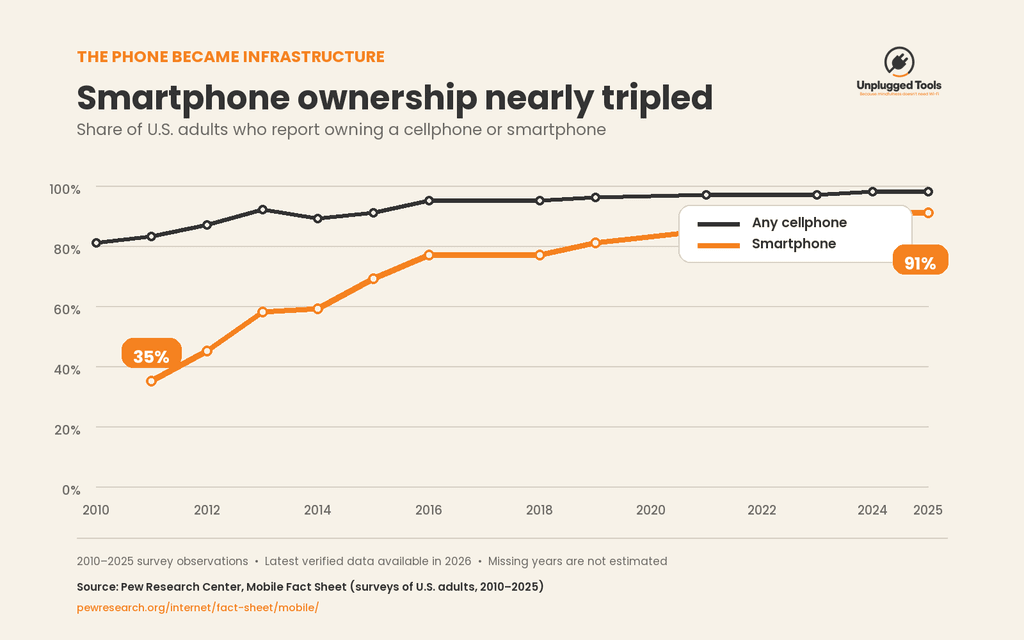
Smartphones became ordinary infrastructure remarkably quickly. Pew Research Center reports that smartphone ownership among U.S. adults rose from 35% in 2011 to 91% in 2025. That does not mean 91% of adults are addicted. It means the device has become the default environment in which communication, work, entertainment, habits, and persuasive app design operate.
The three signals that matter most: control, cost, and compulsion
Most useful assessments of problematic behavior circle around three practical ideas.
1. Control: Can you use the phone as intended?
You planned to answer one message. Did you stop after answering it? You planned to spend ten minutes on social media. Could you leave after ten minutes without repeatedly extending the session? You decided the phone would stay outside the bedroom. Did that boundary survive an ordinary stressful evening?
Loss of control does not mean you fail every time. It means a meaningful gap keeps appearing between your intentions and your actions. You make clear plans, sincerely want to follow them, and regularly find that the device has carried you somewhere else.
2. Cost: Is the behavior interfering with your life?
Look for displacement. Phone time has to come from somewhere. It may come from sleep, movement, focused work, play, boredom, conversation, sex, hobbies, or simply the quiet mental space in which you notice what you feel.
The cost may be dramatic, such as checking a message while driving. More often it is incremental. You are physically present with your family but continually half-absent. You avoid beginning difficult work. You stay up forty minutes later than intended. You stop reading because a book cannot compete with a feed that changes every half second. No single evening ruins your life. The repeated trade becomes your life.
3. Compulsion: Do you keep returning despite wanting something different?
A habit is automatic. A compulsion feels harder to resist and may continue despite negative consequences. You might experience agitation when the phone is unavailable, repeatedly check without expecting anything, conceal how much you use it, or return immediately after deciding to stop.
These experiences do not prove a diagnosis. They do show that “just use more willpower” is probably an incomplete strategy. The behavior may be performing a job—relieving boredom, avoiding an emotion, offering social reassurance, delaying uncertainty, or providing an easy reward when real life feels demanding.
A practical 12-question phone-use self-check
Answer these questions based on the last four weeks, not your worst day and not the version of yourself you hope to become. Use the following scale:
- 0 — Never or almost never
- 1 — Occasionally
- 2 — Often
- 3 — Very often
This is an original reflection tool informed by recurring concepts in research scales—such as loss of control, functional impairment, preoccupation, tolerance, withdrawal-like discomfort, and persistence despite consequences. It is not a validated diagnostic instrument and should not be used to diagnose yourself or anyone else.
- I unlock my phone automatically and only afterward realize I did not have a clear reason.
- I remain on apps substantially longer than I intended.
- I have repeatedly tried to reduce my phone use but quickly returned to the same pattern.
- I feel restless, irritable, unusually anxious, or preoccupied when I cannot check my phone.
- I need increasingly stimulating, frequent, or extended phone use to feel satisfied.
- My phone use delays sleep, interrupts sleep, or makes it harder to wind down.
- I check my phone during conversations, meals, work, driving, or other situations where my attention matters.
- Phone use causes me to postpone responsibilities or makes focused tasks take longer.
- I spend less time on exercise, outdoor activity, hobbies, reading, relationships, or rest because of my phone.
- I use my phone primarily to escape boredom, loneliness, stress, sadness, conflict, or an uncomfortable task.
- I minimize, hide, or feel defensive about how much I use my phone.
- I continue the same pattern even though I can name ways it is making my life worse.
How to interpret your answers without pretending this is a diagnosis
Do not obsess over producing one grand total. Look at the pattern.
| Pattern | What it may indicate | A useful next step |
|---|---|---|
| Mostly 0s and 1s, with little interference | Your use may be heavy but largely intentional or functional. | Protect the routines that are working and audit periodically. |
| Several 2s around automatic checking | A strong habit loop may be operating even if major damage is limited. | Reduce cues and practice interrupting one urge at a time. |
| Several 2s or 3s involving sleep, work, safety, or relationships | Your phone use is creating meaningful functional interference. | Use a structured reduction plan and consider outside support. |
| Repeated failed attempts plus severe distress or impairment | The pattern may be difficult to change through self-help alone. | Talk with a qualified mental-health professional. |
A high answer on one safety-related question can matter more than a dozen low answers elsewhere. Checking while driving, losing substantial sleep, neglecting children, or missing essential responsibilities deserves action even if your overall screen-time report looks ordinary.
Four phone-use profiles that are commonly mistaken for one problem
“I use my phone too much” can describe several different patterns. Identifying yours makes the solution less generic.
The automatic checker
You check during transitions: waiting for coffee, walking between rooms, reaching a stopping point at work, hearing another person’s notification, or feeling a half-second of uncertainty. The check is often not pleasurable. It is simply available.
Your central problem is cue-driven automaticity. Begin with friction: move tempting apps off the home screen, disable nonessential notifications, keep the phone out of reach, and add a physical pause before unlocking. Our article on why you check your phone without deciding to explains this loop in more detail.
The emotional escape user
You reach for the phone most strongly when you feel bored, lonely, rejected, overwhelmed, or unsure what to do next. The phone is not merely entertainment. It is rapid emotional anesthesia.
Removing the device without replacing its function can make the original feeling louder. Your plan needs an offline response menu: walk outside, write one page, call someone, shower, stretch, do a small household task, or sit with the feeling long enough to name it. If the underlying distress is persistent or severe, professional support may be more appropriate than another productivity system.
The practical power user
Your phone is a calendar, camera, map, payment device, authentication key, work terminal, family command center, accessibility aid, and communication tool. Your screen-time total looks enormous partly because modern life has been compressed into one rectangle.
You may not need to “detox.” You need separation by function. Keep the utilities; restrict the feeds. Move optional activities to a computer. Use paper for planning. Distinguish creation, coordination, and connection from passive consumption. Judge the device by whether it serves your intentions, not by whether it appears in your hand.
The high-cost compulsive user
You repeatedly fail to stop, experience strong distress without access, hide the extent of your use, and continue despite significant consequences. Sleep, school, work, relationships, finances, sexual behavior, or safety may be affected.
This is the profile where a casual “turn off notifications” article becomes inadequate. A licensed clinician can help evaluate whether anxiety, depression, ADHD, trauma, obsessive-compulsive symptoms, another behavioral addiction, or a different condition is contributing. The point is not to shame you. It is to stop asking a small tool to solve a larger problem.
Why your screen-time number cannot answer the question
Screen-time dashboards are useful measurements, but they are blunt instruments. They combine navigation with doomscrolling, video calls with short-form video, writing with shopping, and work messages with midnight checking. They also miss the quality of the moment.
Two people can each record four hours. One used the phone for work, a workout, navigation, and a long call with a distant parent. The other cycled through feeds during work, dinner, and bedtime while feeling worse afterward. The number is identical. The relationship is not.
A more revealing audit asks:
- Purpose: Did I know why I opened the phone?
- Agency: Could I stop when the purpose was complete?
- Aftereffect: Did I feel informed, connected, or capable—or scattered, numb, and dissatisfied?
- Displacement: What did this session replace?
- Context: Was this an appropriate moment to use it?
If you want to establish a baseline before changing anything, use our practical screen-time audit. Measurement is most useful when it leads to a decision, not when it becomes another dashboard you check compulsively.
Why apps are unusually good at keeping the loop alive
Your phone is not a neutral container filled with equally passive tools. Many apps make money when you return frequently, stay longer, view more advertisements, provide more data, or make more purchases. That does not require a secret conspiracy. It requires a business model and competent product design.
Infinite feeds remove natural stopping cues. Autoplay prevents the small decision that used to happen between episodes. Notifications create external prompts. Streaks make absence feel like loss. Recommendations reduce the effort required to find the next rewarding item. Variable social feedback—a meaningful message sometimes, nothing important most of the time—teaches you that the next check might pay off.
These features do not mind-control everyone who encounters them. They change the environment in which your self-control operates. Expecting yourself to win every contest against a device that is available all day, customized to your history, and designed to remove friction is not a character-building exercise. It is bad systems design.
This is also why relying exclusively on another phone app to solve the problem can be awkward. Native app limits and tracking tools can help, and app-based interventions have produced benefits in some studies. But the intervention still lives on the object you are trying to use less. Timers can be overridden. Reports can become background noise. A blocker removes an option without necessarily helping you build a satisfying replacement.
In a randomized study, researchers tested a package of behavioral changes including disabling nonessential notifications, keeping the phone away from the bed, hiding or deleting high-use apps, using a computer for certain tasks, and changing the display to grayscale. The intervention group reduced screen time more than a monitoring-only control group. The results for mood and cognition were not consistently different between groups, so the study should not be treated as proof that using your phone less will cure depression or transform your brain. It does suggest that changing several parts of the environment can outperform merely watching the number. Read the randomized controlled trial.
A seven-day experiment is more informative than a label
If you are unsure whether your pattern is serious, run an experiment. Do not promise to become a person who barely owns a phone. Change a few conditions for one week and observe what happens.
Day 0: Record the baseline
Write down your average daily screen time, most-used apps, number of pickups if available, bedtime use, and three situations where checking feels most automatic. Then answer three questions: What does my phone genuinely help me do? What does it repeatedly interrupt? What would I like to do with some of the recovered time?
For seven days: change the environment
- Remove nonessential notifications.
- Keep the phone outside the bedroom or beyond arm’s reach.
- Choose two daily phone-free locations or events.
- Move the most tempting app off the home screen—or remove it temporarily.
- Use paper for the one plan, list, or reflection you check most often.
- Prepare three offline replacements that are easy enough to do when tired.
- Tell important people how to reach you for something urgent.
At the end: evaluate quality, not perfection
Notice your urges. Did they peak at particular times? Did boredom become uncomfortable? Did sleep, conversation, work, or mood feel different? Which boundary helped? Which one was unrealistic? What did you do with the time?
If the experiment creates immediate relief and the boundaries are maintainable, you may be dealing primarily with a powerful habit and an overly permissive environment. If the experiment produces intense distress, repeated circumvention, or exposes substantial underlying anxiety or depression, that is useful information too. It may be time to involve someone qualified to help.
When to seek professional support
Self-help is reasonable when the consequences are mild to moderate, you retain some ability to change the environment, and the experiment feels safe. Consider talking with a physician or licensed mental-health professional when:
- phone use is creating serious problems at work, school, home, or in relationships;
- you use the phone while driving or in other dangerous situations;
- you consistently sacrifice necessary sleep;
- you experience severe anxiety, depression, panic, or emotional distress;
- online gambling, pornography, shopping, gaming, or another specific behavior is causing harm;
- you repeatedly cannot reduce use despite significant consequences;
- you suspect another condition is contributing; or
- you simply feel unable to regain control alone.
Johns Hopkins Medicine similarly emphasizes loss of control, difficulty regulating use, withdrawal-like discomfort, and interference with daily functioning. A professional can assess the whole picture rather than reducing your life to a screen-time screenshot.
If you are in immediate danger, experiencing a mental-health crisis, or thinking about harming yourself, contact local emergency services or a crisis resource in your country. A printable workbook is not emergency or clinical care.
Choose the smallest reset that matches the problem
You do not need to adopt the identity of “phone addict” to make a change. You need an intervention proportional to the pattern you found.
- One automatic urge: Use the free 10-Minute Phone Urge Reset. It gives you a paper-based pause between the cue and the check.
- A recurring pattern you want to test: Use the 7-Day Unplugged Reset. It turns awareness into a short, structured experiment.
- Several habits are affecting your wider life: Use the 30-Day Unplugged Reset to rebuild boundaries, replacements, and a more intentional offline routine.
These are educational tools, not treatment. Their advantage is that the plan does not live inside the device that keeps interrupting the plan.
The answer is not a verdict
So, are you actually addicted to your phone?
Maybe “addicted” is the best everyday word for what you are experiencing. Maybe the more accurate description is a strong habit, emotional avoidance, compulsive use of one particular app, or a practical device that has accumulated too many jobs. The label matters less than three facts: whether you can use the phone as intended, whether it is costing you parts of life you value, and whether you can change the pattern when you decide to.
If your answers show little interference and plenty of control, you do not need internet panic. Keep using a useful tool thoughtfully. If they show automaticity and drift, add friction and run a seven-day experiment. If they show repeated loss of control and meaningful harm, take the problem seriously and ask for support.
Your phone does not need to be evil for your relationship with it to need boundaries. You do not need to throw it into a lake, buy a cabin, or become the sort of person who lectures strangers about dopamine. You only need to stop letting the device make every small decision by default.
For the practical next step, read How to Break Phone Addiction. It picks up where this self-check ends and shows you how to redesign the cues, access, and offline alternatives that shape your day.