If you are trying to figure out how to break phone addiction, start with one small moment: the instant you reach for your phone before you have decided what you actually want from it.
There may be no notification, no urgent message, and no particular reason to open an app. You might be waiting for coffee, struggling with a difficult task, sitting through a quiet moment, lying in bed, or simply encountering a few seconds with nothing assigned to them. Your hand moves anyway. You unlock the screen, check something, and sometimes find yourself scrolling before you consciously decided to use your phone at all.
It is tempting to treat that behavior as evidence that you lack discipline. It is usually more useful to treat it as a practiced response. Phones become attached to cues, and repeated checking can become habitual enough that the movement begins before the decision.
“Phone addiction” is a common phrase for feeling unable to control your phone use, but automatic or compulsive phone checking does not by itself establish that you have a clinical addiction. A behavior can be habitual, unwanted, and disruptive without proving that something is medically wrong with you. You also do not have to decide whether the word addiction perfectly describes your experience before you start changing it.
The 10-Minute Phone Urge Reset is a practical exercise for interrupting one automatic phone check before it becomes another scrolling session. It does not require deleting every app, buying a minimalist phone, downloading another digital-detox application, or swearing off technology. You simply create a small amount of space between the urge and your response so that using your phone becomes a decision again.
Technology is a tool. The point is to use it on purpose.
Why Breaking Phone Addiction Starts Before You Unlock the Screen
If your goal is to break a phone addiction or reduce unwanted phone use, it helps to stop thinking of “my phone” as one enormous problem.
Your phone is probably involved in genuinely useful parts of your life. You may use it for directions, work, photographs, banking, calendars, music, communication, emergencies, or staying connected to people you care about. Trying to eliminate all phone use would solve a problem you probably do not have.
Instead, identify the use you do not actually want.

Maybe you repeatedly check social media while working. Maybe you reach for your phone every time a television show slows down. Maybe you check messages even though you know nothing has arrived. Maybe you open one app, close it, and then open it again a few minutes later. Maybe you bring your phone to bed intending to check one thing and lose forty minutes to scrolling.
Those are more specific problems, and specific problems are easier to redesign.
Phone checking can become habitual: a behavior initiated by a familiar situation rather than a freshly considered decision. In a small experimental study of 62 college students, visible phone cues were associated with more phone-use behavior, especially when participants were not instructed to exert self-control. The authors cautioned that habitual checking should not automatically be equated with a clinical disorder or addiction. The study population was also narrow, so its findings should not be generalized to everyone. You can read the open-access smartphone cue study for the authors’ methods and limitations.
If you want to understand that behavior in more detail, read Why Do I Keep Checking My Phone?. For this exercise, the important part is recognizing the basic route.
The Automatic Phone-Checking Loop
Cue → Reach → Check → Result
A pause, feeling, place, sound, difficult task, notification, or visible phone becomes a cue. Your hand begins the familiar movement, you check the screen, and whatever happens next gives you another repetition of the same route.
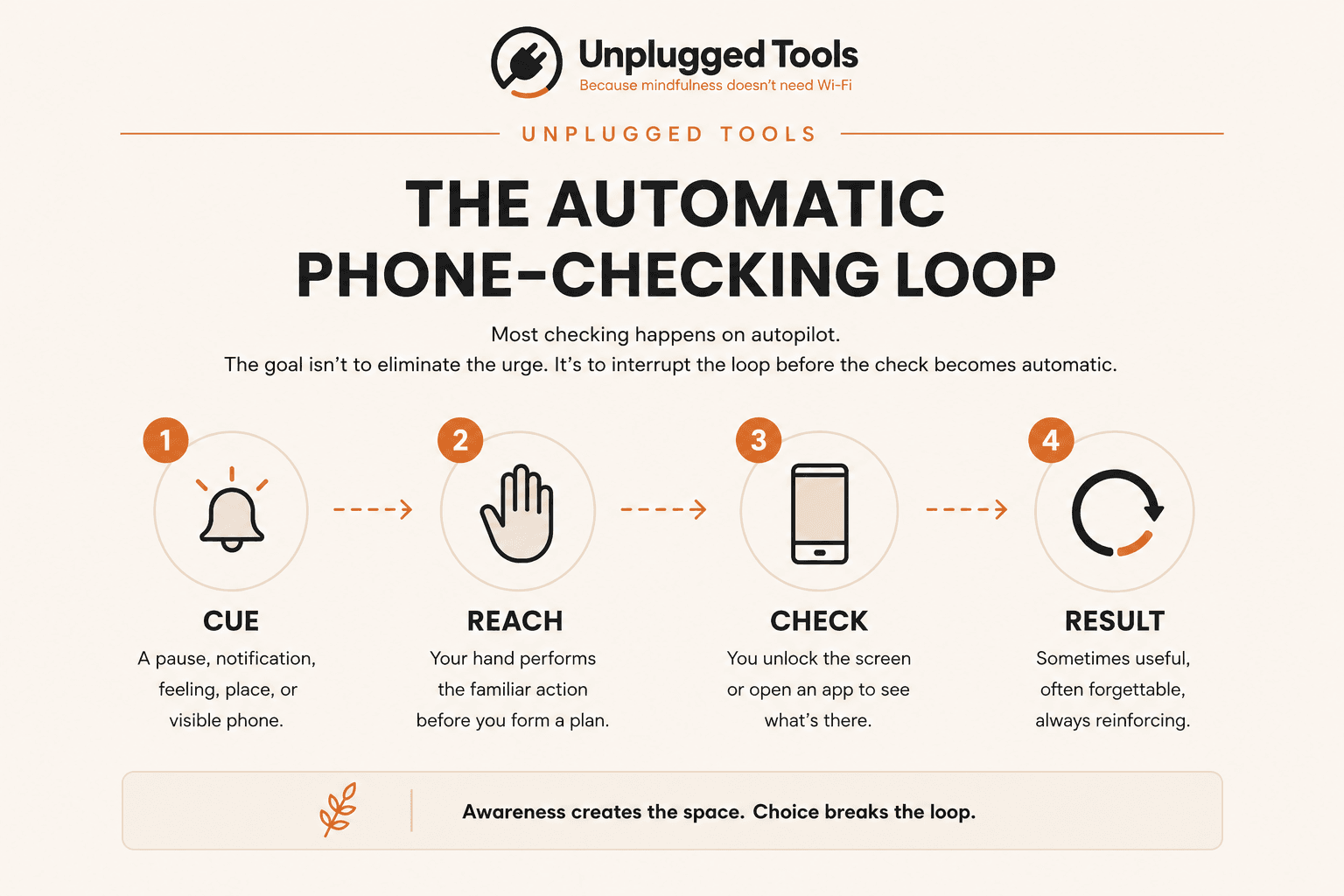
The result does not even need to be particularly rewarding. Sometimes you find a meaningful message or something genuinely entertaining. Other times there is nothing there. The possibility that there might be something can still be enough to begin the movement.
If you want to change the habit, the useful place to intervene is often before the check.
The Point of Ten Minutes
Ten minutes is not a scientifically established magic number. It is a deliberately modest container: long enough to interrupt an automatic sequence, short enough to try without reorganizing your day. You are not promising to stay offline forever. You are postponing one unplanned check while you observe what the urge is actually made of.
That distinction matters because attempts to stop phone addiction can become unnecessarily dramatic. You notice that you are spending too much time on your phone, become frustrated, delete several apps, establish a collection of strict rules, and expect yourself to become a different person by Monday morning. The rules eventually become inconvenient, the apps return, and the old routines gradually reappear.
A smaller experiment asks less of you. Instead of solving your entire relationship with technology today, you practice interrupting one automatic response.
Research on implementation intentions offers a useful principle here. An implementation intention is an if-then plan: “If situation Y occurs, then I will perform response X.” Systematic reviews across several behavior-change domains suggest that these plans can help people translate intentions into action, although results vary by goal, context, and population.
Evidence from smoking cessation, exercise, prospective memory, or clinical samples does not directly prove that an if-then plan will reduce your phone use. It does support the broader idea that choosing a response in advance can be more useful than inventing one while you are already confronting the cue. See the meta-analysis of implementation intentions and prospective memory for an overview of the method.
Your Phone-Urge Rule
If I notice that I am reaching for my phone without a specific purpose, then I will put it down, start a ten-minute timer, and complete the reset before deciding whether to check it.
You are not promising that you will not use your phone. You are deciding when the decision gets made.
That sentence removes a negotiation. You do not have to invent a strategy while your thumb is already hovering over an icon.
The 10-Minute Phone Urge Reset
Use these steps in order the first few times. Once you understand the sequence, adapt it to fit your life. The reset is a tool, not a ceremony.
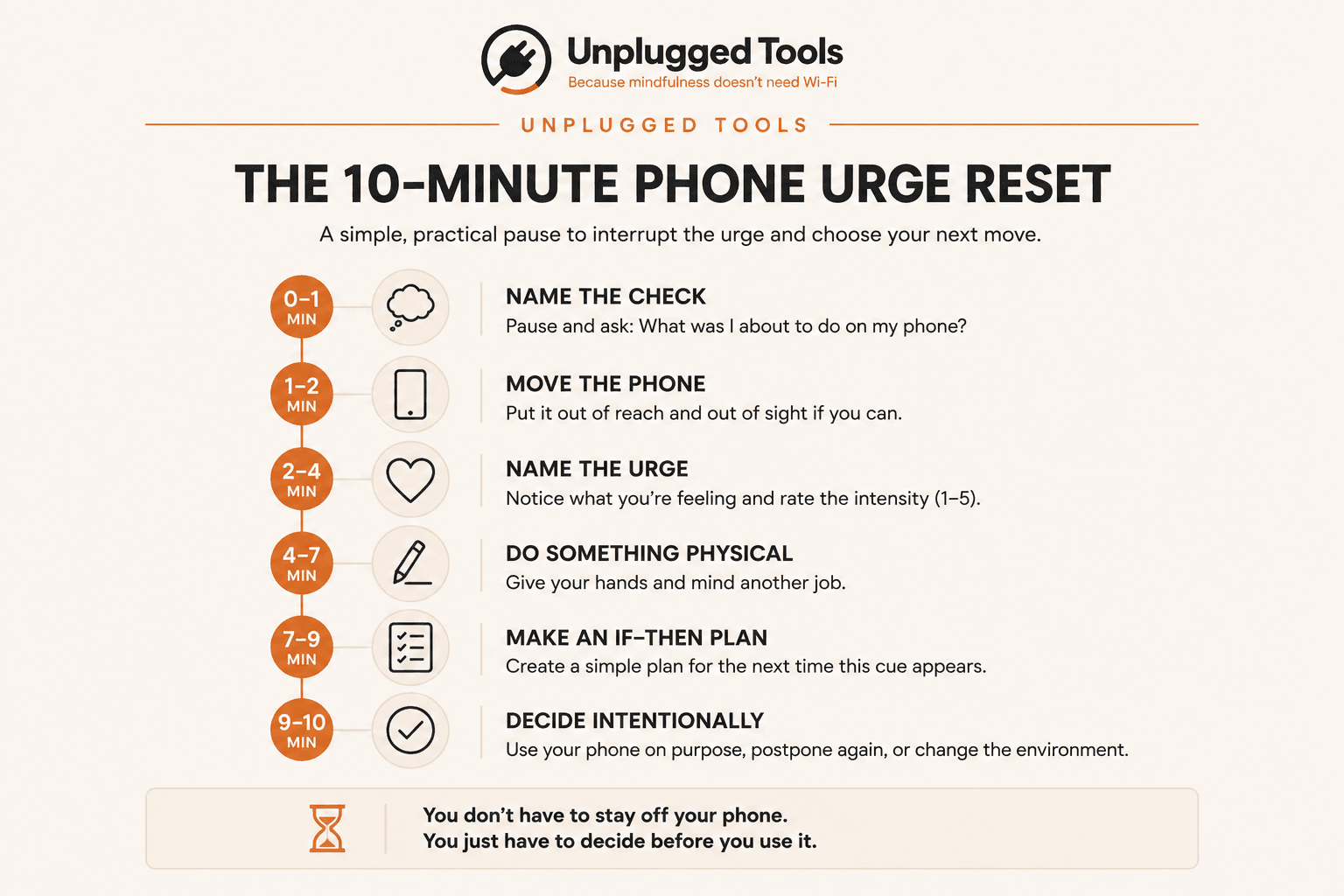
Minute 0–1: Name the Check
Stop before unlocking the phone if you can and ask one concrete question: What was I about to do?
“Check my phone” is too vague. Name the intended action instead. Maybe you were going to read a message from a particular person, look up tomorrow’s weather, check your bank balance, or find directions. Those are purposes.
Other answers reveal something different. Maybe you were about to open social media because your work became uncomfortable, see whether anything new had happened, avoid the next part of a task, or escape a quiet moment.
If you have a clear and time-sensitive purpose, use your phone for that purpose. Intentional use is not failure, and breaking an unwanted phone habit does not require treating every unlock as a mistake.
If the answer is essentially “I don’t know,” put the phone down and continue.
Minute 1–2: Change the Physical Cue
Move the phone out of immediate reach. Put it in a drawer, bag, charging station, on a shelf across the room, or somewhere else that requires a deliberate movement to retrieve it.
Face down is better than face up, but distance is usually clearer than symbolism.
If you need to remain reachable for children, family, work, or emergencies, keep the appropriate calls available. The exercise does not require making yourself unreachable. The point is to remove the phone from the location where picking it up requires almost no thought.
This is environmental design, not a failure of self-control. The cue study described earlier suggests that visibility can matter. A phone sitting on your desk continues to make a small proposal every time your eyes pass over it.
If you repeatedly struggle with unwanted phone use in the same location, that information is valuable. The long-term solution may have less to do with becoming better at resisting the phone and more to do with changing where the phone lives during that part of your day.
Minute 2–4: Let the Urge Become Specific
Notice the urge without turning it into a courtroom drama. What are you actually experiencing?
It may be curiosity, boredom, restlessness, loneliness, anxiety, fatigue, avoidance, or discomfort with whatever you were doing before your hand moved toward the phone.
Rate the intensity from 1 to 5.
| Rating | What It Feels Like | What to Try |
|---|---|---|
| 1 | Barely noticeable | Return to what you intended to do |
| 2 | Mild curiosity | Pause briefly and continue |
| 3 | Distracting but manageable | Stand up or change location |
| 4 | Strong and repetitive | Choose a hands-on replacement |
| 5 | Overwhelming or tied to significant distress | Stop the exercise and seek appropriate support if needed |
The number is not a diagnosis or a score to optimize. It is simply a quick way to turn “I need my phone” into a more precise observation.
“I need my phone” does not give you many options. “I am bored and looking for stimulation” does. “I don’t understand the next part of this project and want to escape it” does. “I am wondering whether someone messaged me because I feel lonely” does.
Precision makes it easier to choose a response that addresses the actual need instead of automatically sending every uncomfortable or empty moment through the same rectangular doorway.
Minute 4–7: Give Your Hands Another Job
Choose an activity that begins immediately and has a visible ending. If your goal is to interrupt scrolling, avoid replacements that simply move you to another screen.
Good options include filling a glass of water and drinking it away from your desk, writing the next physical action for your current task on paper, washing one dish, clearing one small surface, stepping outside, stretching, taking one lap around the building, reading two pages of a physical book, or writing down the thing you wanted to search for so you can decide whether it still matters later.

The replacement should match the cue whenever possible. If you reached for your phone because you felt lonely, reorganizing a drawer may keep your hands occupied but may not address what you actually need. An intentional call or making plans with someone might. If you reached because a task was confusing, write the smallest next step. If you reached because you need a break, take an actual break rather than turning five minutes of rest into an open-ended scrolling session.
If you reached because you were bored, allow yourself to do something enjoyable. The alternative to scrolling does not always have to be productive.
The best replacement is not the most virtuous one. It is the one that solves, or at least acknowledges, the problem the phone check was trying to solve.
What to Do Instead of Scrolling
A replacement list works best when you prepare it before you need it. Instead of collecting a hundred admirable activities you will never remember during an urge, build a small personal menu around your most common reasons for reaching.
| If You’re Feeling… | Try This for 2 Minutes | Try This for 10 Minutes |
| Bored | Doodle one object | Walk without headphones |
| Avoidant | Write the next action | Complete one focused work interval |
| Lonely | Write down who you want to talk to | Call someone or make plans |
| Restless | Stand and stretch | Take a short walk outside |
| Curious | Write the question on paper | Research it intentionally later |
| Tired | Close your eyes for a moment | Rest, hydrate, or change tasks |
The purpose of this list is not to turn every free minute into self-improvement. Sometimes the most useful replacement for mindless scrolling is simply looking out the window, sitting on the porch, making coffee without consuming anything, or allowing yourself to be temporarily bored.
For more practical exercises, explore the Digital Habits archive.
Minute 7–9: Make One If-Then Plan
Now use what you noticed to create a response for the next time the same cue appears.
If I notice ____________________, then I will ____________________ before checking my phone.
Make both parts observable. “If I get distracted, I will focus” is fog wearing a tie. You cannot easily tell when you have completed it.
Better plans sound like this:
- If I unlock my phone while writing, I will lock it again and write one imperfect sentence.
- If I want social media while waiting in line, I will keep my phone in my pocket until the line moves.
- If I reach for my phone in bed, I will place it on the dresser and read one page.
- If I want to check messages immediately after waking up, I will get dressed first.
- If I need a break from work, I will walk for three minutes before deciding what to do next.
The point is not to design the perfect rule. It is to remove one decision from the moment when the familiar cue appears.
Minute 9–10: Decide, Don’t Drift
At the end of ten minutes, decide whether you actually want to use your phone.
You have three options:
- Use it intentionally. Name the task, open the necessary app, complete the task, and stop.
- Postpone again. If the urge has weakened and the check is unnecessary, return to your day.
- Change the environment. If the same cue keeps winning, move the phone farther away, remove an app from your home screen, silence an unnecessary notification, or redesign the routine around the cue.
The reset succeeds when it produces a decision. You are not required to avoid the phone at the end.
That is an important distinction if you are trying to break phone addiction without giving up your smartphone. The goal is not to make the device forbidden. The goal is to move phone use from automatic behavior toward intentional behavior.
What Research Can (and Cannot) Promise
The 10-Minute Phone Urge Reset has not been established as a medical treatment for smartphone addiction, and this exercise should not be presented as one. Ten minutes is a practical structure for interrupting a behavior, not a clinically validated dose.
There is, however, experimental research examining what happens when people deliberately reduce smartphone or digital-media use.
In a preregistered eight-day experiment involving 338 Gen Z participants, researchers compared restrictions on digital media, social media, water use, and no restriction. The design helps separate some causal questions from purely observational ones, but its age group, short duration, and specific interventions limit how broadly the findings should be generalized. You can read the randomized study of digital-media restriction and well-being for the full details.
A separate randomized trial assigned 111 healthy students to reduce smartphone screen time to two hours per day for three weeks or continue as controls. The intervention group showed small-to-medium improvements on several self-reported measures immediately after the intervention. Smartphone screen time then increased quickly afterward and approached baseline at follow-up. See the 2025 randomized screen-time reduction trial.
That rebound deserves attention. A short period of motivation can change behavior temporarily. Maintaining that change is a different problem. If the environment, cues, and routines that produced your unwanted phone use remain exactly the same, relying on motivation alone can eventually become exhausting.
Neither study proves that everyone should aim for a particular amount of daily screen time, and neither validates dramatic claims that a ten-minute exercise will “reset your dopamine,” “repair your brain,” or cure an addiction.
The sensible conclusion is smaller: deliberate reductions in digital-media use can be studied experimentally, some short-term benefits have been observed in particular samples, and maintaining behavior change can be difficult.
A ten-minute reset is best understood as practice in intentional use—not a medical treatment for addiction.
How to Stop Phone Addiction From Creeping Back
If you repeatedly complete the reset and then return to the same unwanted patterns, do not assume that the exercise failed. Look for the pattern underneath the pattern.
Perhaps your phone is always beside you while you work. Perhaps you charge it next to your bed. Perhaps every app can send notifications. Perhaps social media occupies the easiest-to-reach position on your home screen. Perhaps every moment of boredom has become a cue for entertainment.
Those conditions matter because sustainable change becomes easier when your environment supports the behavior you want.
1. Move the Phone Before You Need Willpower
Do not keep the phone visible as a test of discipline. You do not earn extra points for resisting an object that keeps asking for your attention.
If the same location repeatedly produces automatic checking, establish a different home for the phone during that activity. The desk, dinner table, bed, couch, bathroom, and passenger seat do not all have to be phone locations.
2. Reduce Unnecessary Cues
Not every app deserves permission to interrupt you. Notifications can be useful when information genuinely requires your attention. Others simply announce that an application would like you to reopen it.
Consider which notifications actually deserve immediate access to you and which can wait until you intentionally open the app.
3. Make the Unwanted Behavior Slightly Harder
You do not necessarily need an elaborate blocking system. Small amounts of friction can be useful.
Remove a frequently checked app from your home screen. Log out. Keep your charger outside the bedroom. Put the phone in a bag instead of your pocket during a walk. Leave it in another room during a focused work period.
The goal is not to make phone use impossible. It is to create enough friction that your mind has time to catch up with your hand.
4. Don’t Replace One Feed With Another
Switching from social media to news, video, shopping, email, or another feed may preserve the same automatic sequence.
If your goal is to interrupt compulsive scrolling, choose replacements that feel physically different from scrolling. Walk, write, cook, stretch, talk, build, read, clean, draw, sit outside, or simply let a quiet moment remain quiet.
5. Don’t Treat Screen Time Like a Grade
Screen-time totals can help you notice patterns, but they cannot tell you whether the time was necessary, meaningful, enjoyable, or unwanted. Three hours spent navigating during a road trip is different from three hours spent opening an app you did not particularly want to open.
If you do not know where your time is actually going, use the practical screen-time audit to examine your phone use before deciding what you want to reduce.
Common Mistakes That Make the Reset Harder
1. Turning Every Urge Into a Moral Failure
Shame adds distress without changing the cue. Describe the behavior plainly instead: “I opened social media when the report became difficult.”
That sentence contains information you can use.
2. Trying to Quit Everything at Once
A dramatic digital detox can feel satisfying because the rule is simple: none of it. Ordinary life is more complicated.
Instead of trying to eliminate every undesirable digital habit simultaneously, identify one repeated pattern and redesign it. Once that becomes easier, choose another.
3. Demanding That the Urge Disappear
An urge can remain present while you make another choice. The objective is not perfect calm or complete indifference to your phone. It is a little more agency.
4. Treating Necessary Phone Use as Failure
Using navigation, answering an important message, taking a photograph, listening to music, or deliberately enjoying something on your phone does not invalidate the exercise.
The target is unwanted automatic use, not technology itself.
5. Downloading More Technology Without Examining the Habit
A blocking app, screen-time tool, or digital-detox application can be useful for some people. But before adding another layer of technology, ask what you are actually trying to change.
If the problem is that Instagram is beside your thumb whenever work becomes difficult, the first solution might simply be moving Instagram and moving the phone.
Use tools when they solve a specific problem, not because reducing technology somehow requires purchasing more technology.
Try It for One Week
For seven days, use the reset once per day when you notice a genuine unplanned urge. You do not need to record every unlock or spend the week policing yourself.
Record only four things:
- What triggered the reach?
- How strong was the urge from 1–5?
- What did you do instead?
- Did you still choose to use the phone after ten minutes?
At the end of the week, look for repetition.
You may discover that what felt like one enormous problem called “phone addiction” is actually a collection of smaller habits. Perhaps most of your unwanted use happens after dinner. Perhaps one particular app accounts for the majority of it. Perhaps you check messages when you feel uncertain or lonely. Perhaps the phone becomes irresistible only when you are doing difficult work. Perhaps almost all of your unwanted scrolling begins in bed.
Specific problems are easier to redesign. Instead of “I need to stop using my phone,” you can say, “I don’t want social media in bed.” Instead of “I have no self-control,” you can say, “When work becomes confusing, I reach for my phone.” Instead of “I waste my entire life scrolling,” you can say, “The first thirty minutes after dinner are where I usually lose track of what I intended to do.”
Those statements give you somewhere to begin.
A Small Reset Is Still Real Practice
There probably is not one dramatic moment when your phone permanently loses its appeal. You also do not need one.
Breaking an unwanted phone habit can be much less dramatic: notice the cues that make you reach, create distance from the ones you can control, prepare a few alternatives for the needs underneath the urge, and practice deciding before you open the screen.
Some days you will still scroll longer than you intended. Sometimes you will pick up the phone without thinking. Sometimes you will complete the ten-minute reset and then deliberately use your phone anyway. None of those outcomes makes the exercise meaningless.
The skill you are practicing is not perfect abstinence. It is noticing the small gap between wanting to check and checking.
The next time your hand moves before your mind has named a purpose, do not make a speech about discipline. Put the phone down. Give yourself ten minutes. Notice the cue, give your hands another job, and decide what happens next.
Keep the Reset Somewhere You Can Actually Use It
You should not need to open another browser tab every time you are trying to spend less time on your phone.
Get the free printable 10-Minute Phone Urge Reset and keep it where your most automatic checking happens: beside your desk, on your nightstand, near the couch, or wherever your phone tends to become the default.
No app. No account. Just a practical interruption between the urge and the scroll.